

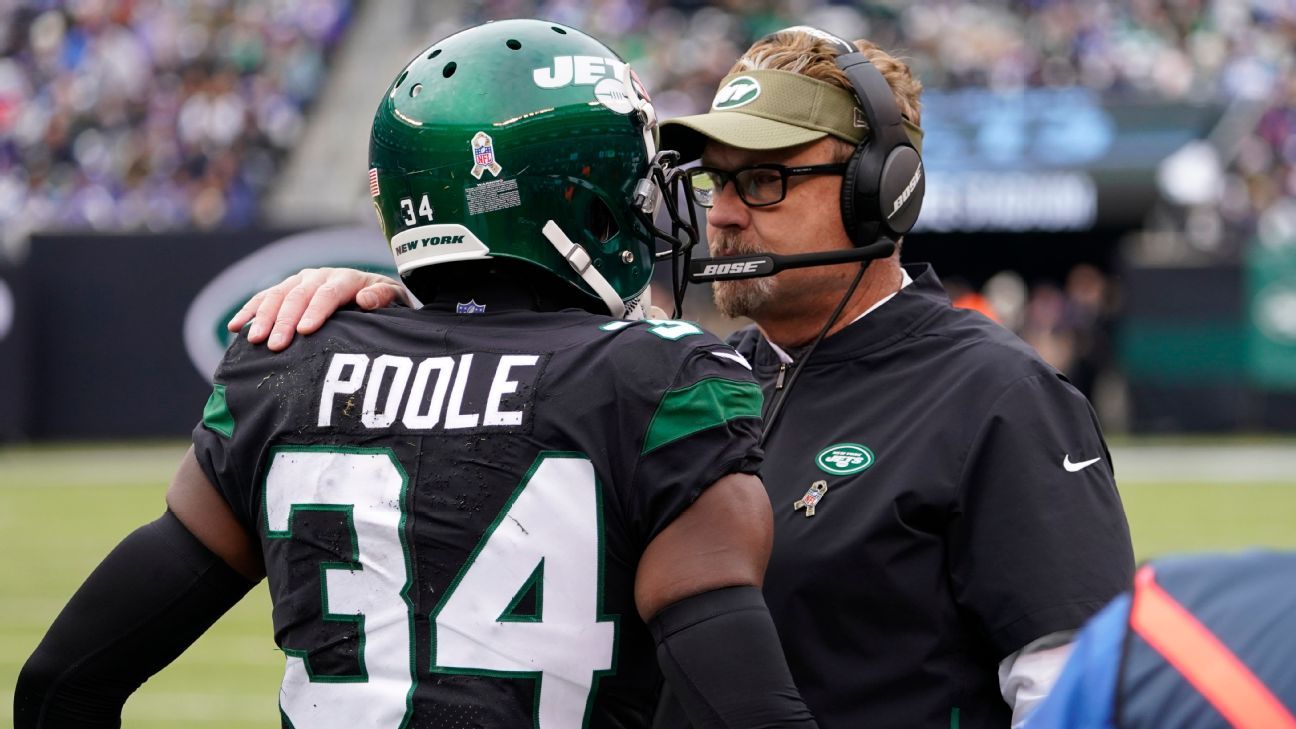
Defensive coordinator Gregg Williams has a longstanding tradition: Every new player on defense must perform 40 up-downs before his first practice, with the entire unit gathered around him. This season, Williams has presided over more calisthenics than a personal trainer.
Because of injuries, particularly at linebacker and cornerback, the Jets have employed 35 defensive players on the 53-man roster through the season (not to mention 10 unique starting lineups). Instability often is a recipe for disaster, but Williams has performed a small miracle: one of the best coaching jobs this team has seen in a long time. The Jets are fifth in DVOA (defense-adjusted value over average), eighth in total defense and first in rushing defense.
Maybe that second "g" in Williams' first name really does stand for genius.
"I think he's done a really good job of figuring out who he has, what they can do, what their strengths are, what their weaknesses are and how to kind of operate week to week, considering that he's had some moving pieces coming in and out," Jets coach Adam Gase said.
Williams has done a terrific job with scheme and personnel. Specifically:
Personnel: In last week's 34-3 victory against the Oakland Raiders, Williams played a patchwork lineup that included journeymen and inexperienced players. Of the 16 players who logged the most snaps, seven entered the league as undrafted free agents and two were former sixth-round picks. Every team preaches the "next man up" mentality, but few actually make it work. Williams has figured out a way to play good defense without his most accomplished player (linebacker C.J. Mosley has missed nine games) and, in recent weeks, without his best lineman (Leonard Williams, traded).
Scheme: Because of injuries at cornerback, Gregg Williams has reinvented his approach. Instead of the usual heavy doses of blitzing and man-to-man coverage, he has dialed back the pressure in recent weeks (except for occasional blitzes by safety Jamal Adams). Against the Raiders, the Jets blitzed a season-low 11.4% of the pass plays and played Cover 2 a season-high 25%, according to ESPN Stats & Information research. The objective, of course, was to protect his replacement corners, Arthur Maulet and rookie Blessuan Austin. Williams needs blitzing almost as much as he needs oxygen, but he has adjusted to fit his personnel. That's what good coaches do.
This impressive run of plug-and-play has required some on-the-fly coaching by Williams and his staff, but the foundation was set in the spring. That's when they started cross-training players at different positions and installing the entire playbook, not just certain concepts. The early exposure has allowed the players to adapt to new roles and new schemes along the way.
The Jets aren't overflowing with talent on defense, but they're relentless overachievers. It's been a long time since they were known that way.
 www.espn.com
Because of injuries, particularly at linebacker and cornerback, the Jets have employed 35 defensive players on the 53-man roster through the season (not to mention 10 unique starting lineups). Instability often is a recipe for disaster, but Williams has performed a small miracle: one of the best coaching jobs this team has seen in a long time. The Jets are fifth in DVOA (defense-adjusted value over average), eighth in total defense and first in rushing defense.
Maybe that second "g" in Williams' first name really does stand for genius.
"I think he's done a really good job of figuring out who he has, what they can do, what their strengths are, what their weaknesses are and how to kind of operate week to week, considering that he's had some moving pieces coming in and out," Jets coach Adam Gase said.
Williams has done a terrific job with scheme and personnel. Specifically:
Personnel: In last week's 34-3 victory against the Oakland Raiders, Williams played a patchwork lineup that included journeymen and inexperienced players. Of the 16 players who logged the most snaps, seven entered the league as undrafted free agents and two were former sixth-round picks. Every team preaches the "next man up" mentality, but few actually make it work. Williams has figured out a way to play good defense without his most accomplished player (linebacker C.J. Mosley has missed nine games) and, in recent weeks, without his best lineman (Leonard Williams, traded).
Scheme: Because of injuries at cornerback, Gregg Williams has reinvented his approach. Instead of the usual heavy doses of blitzing and man-to-man coverage, he has dialed back the pressure in recent weeks (except for occasional blitzes by safety Jamal Adams). Against the Raiders, the Jets blitzed a season-low 11.4% of the pass plays and played Cover 2 a season-high 25%, according to ESPN Stats & Information research. The objective, of course, was to protect his replacement corners, Arthur Maulet and rookie Blessuan Austin. Williams needs blitzing almost as much as he needs oxygen, but he has adjusted to fit his personnel. That's what good coaches do.
This impressive run of plug-and-play has required some on-the-fly coaching by Williams and his staff, but the foundation was set in the spring. That's when they started cross-training players at different positions and installing the entire playbook, not just certain concepts. The early exposure has allowed the players to adapt to new roles and new schemes along the way.
The Jets aren't overflowing with talent on defense, but they're relentless overachievers. It's been a long time since they were known that way.
Jets defense goes up, up, up with 'up-down' coach Gregg Williams
Instability often is a recipe for disaster, but the D-coordinator has performed a small miracle -- one of the best jobs this team has seen in a while.

